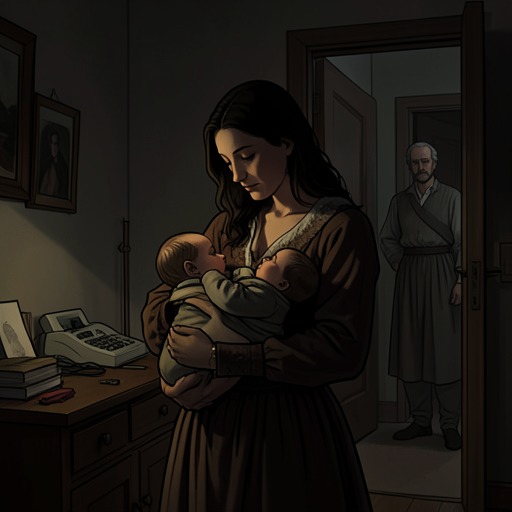
Amaia’s Postpartum Stress
Legado en los huesosAmaia Salazar’s postpartum stress is not simply a matter of fitting childcare around police work. Caring for Ibai exposes her to an exhausting conflict between professional demands and an ideal of perfect motherhood, while her fear of repeating her own mother’s cruelty makes ordinary difficulties feel like evidence against her. The strain appears in her body—in tears, trembling, and vomiting—as well as in arguments with James and in the childhood memories that later give her fears a family history.
Feeding, Guilt, and the Crying Baby
When Amaia returns to find Ibai crying in James’s arms, she is already convinced he has been left hungry for too long. James tries to reassure her: the baby is all right, he has held him the whole time, and the intense crying has lasted only a few minutes. Amaia nevertheless takes Ibai from him and carries him into the sitting room, challenging James’s idea of what counts as a short time to cry. Her anger is directed at him, but the scene quickly turns inward: once Ibai is at her breast, his desperate search and strong sucking stop the crying almost at once.
That sudden quiet does not relieve Amaia. As Ibai feeds calmly and falls asleep, she closes her eyes in anguish and blames herself for having been distracted and allowed him to go hungry. She strokes the soft hair on his head with a trembling hand; a tear falls onto him while he remains unaware of her distress. James wipes the tears from her face and again insists the baby has not suffered. The mismatch between his reassurance and her conviction that she has failed makes the episode more than a disagreement about how long Ibai cried: she experiences his distress as proof of her own inadequacy. After she hands the settled baby back to James and leaves the room, he hears her vomit.
Work, Breastfeeding, and Exhaustion
The pressure recurs in the logistics of Amaia’s work. While arranging to meet a judge and waiting for the forensic report, she calculates whether she can get to Elizondo in time to give Ibai his afternoon feed. James has to go ahead with the baby; Amaia expects to join them after her meeting and hurries in the hope of making the three o’clock feeding. Her attention to the hour conveys how thoroughly her day is divided between police obligations and the baby’s needs.
When she arrives, James is trying to give Ibai a bottle. The baby alternates whimpers, cries, and gasps of displeasure, yet sucks fiercely at it; after twenty minutes, he has taken only twenty centiliters. Amaia opens her arms, takes him, and greets him affectionately, apologizing for arriving late and telling him she is there now. She also admits that she misses him and hopes he has missed her. The scene makes the separation mutual in feeling but unequal in its burden: James has been caring for Ibai, while Amaia is trying to resume work, travel across town, and return in time to feed him.
Marriage Under Pressure
The reunion might have become a moment of comfort between Amaia and James. Their eyes meet, and for a couple of seconds she nearly runs into the embrace that has come to symbolize their shared care and closeness. Instead, frustration overtakes her. She is tired, has not eaten, has come from an autopsy, and has been rushing from one place to another with scarcely any time to herself. James tells her he misses her; her immediate thought is that she misses herself. She resents his sorrowful manner because it does not help with the exhaustion she is carrying, then recognizes that her irritation is unfair: James is a good father and a deeply considerate husband, but she feels that he cannot understand what this experience is like for her.
James eventually raises the practical question of continued breastfeeding. He suggests that the demands of nursing on a fixed schedule may not fit Amaia’s work and that she might consider switching Ibai fully to a bottle. Amaia does not voice the deeper struggle she is having. She wants to do motherhood well for Ibai, but also for her own sake—for the child she once was, the daughter of a bad mother. In her thinking, being a good mother is not merely something she hopes to achieve; it becomes a test that she must pass to avoid being bad like her own mother. She wonders whether her frustration means that something is wrong, and contrasts the promised happiness of motherhood books with the fatigue and sense of failure she actually feels.
Instead of explaining this fear, Amaia answers defensively that James knew she was a police officer and had accepted that she would always be one. She frames the disagreement as a question of their marriage and his acceptance of her vocation, then leaves the kitchen. The exchange shows how a conversation about feeding becomes entangled with work, identity, and the security of the marriage. Her response protects her professional self, but leaves the more vulnerable question—whether she can be a good mother—unspoken.
Childhood Trauma and Maternal Fear
A later disclosure by Ros Salazar reveals why the prospect of becoming a mother carries such frightening weight for Amaia. As children, the sisters sometimes slept together. One night Ros changed beds while Amaia was asleep; their mother came to Ros’s bed, apparently believing Ros was Amaia, and spoke to her with a threat about eating her. Ros was nearly asleep but heard the words clearly. After their mother left, Ros got up and returned to Amaia’s side, frightened. From then on, she allowed Amaia to sleep beside her and watched their mother. She had never told anyone before.
Amaia comforts Ros, telling her that they were too young to do anything. But she places responsibility on their father, the adult who should have protected her and did not. She recalls that he protected their mother and sent nine-year-old Amaia away from home, separating her from her father and sisters. The memory links Amaia’s fear of being a bad mother to the harm she experienced as a child, while Ros’s long silence and vigilance show how the sisters tried to protect one another within a family that did not protect Amaia. The novel does not present the later feeding struggles as a simple repetition of that abuse; rather, the memory makes clear why Amaia’s own frustration can alarm her so intensely.
The Family Secret in Retrospect
Another later conversation brings the family’s hidden history closer to the question of motherhood. When people discuss why Rosario Iturzaeta said that one baby had been stillborn but did not mention another baby, the explanation is that she had to disclose the dead child in order to bury her there. Amaia feels her heart stop for an instant as she hears this account. The revelation does not erase the practical pressures of work or prove that they alone explain her postpartum distress. It does, however, place her efforts to understand what makes a good mother against a history in which pregnancy, a child’s death, and the truth about a birth were concealed. The gap between the mother Amaia fears becoming and the history she is still uncovering gives her exhaustion and self-doubt their deeper emotional stakes.